Infinity Dictate Team
· 8 min read
The visible part of being a content creator is the content itself — the video, the photo, the episode. The invisible part is all the writing that makes it discoverable, shareable, and sustainable. YouTube descriptions, chapter timestamps, social captions, email newsletters, blog posts, scripts, outlines — every piece of content generates its own paper trail of written work. For creators publishing multiple times per week, the writing overhead can easily consume as much time as the content creation itself.
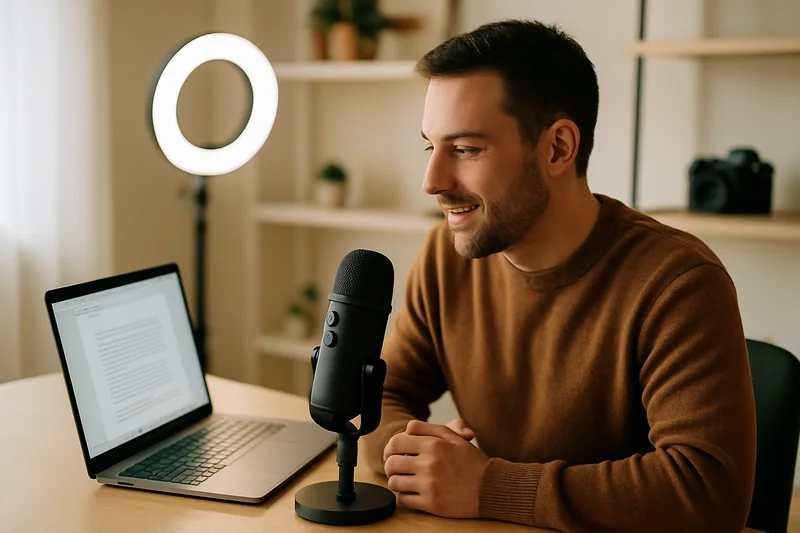
Voice dictation addresses this directly. Because most content creator writing is conversational in register — it's supposed to sound like a real person — speaking it is more natural than typing it. The same voice you use to present on camera works perfectly for dictating scripts and captions. AI auto-polish handles the gap between spoken language and polished written text, leaving you with output that sounds authentic without the time investment of careful typing.
Key Takeaways
- Video scripts are ideal for dictation because they're designed to sound natural when spoken aloud.
- Batching caption dictation for a week of posts takes 10–15 minutes by voice versus an hour or more of typing.
- Blog posts and newsletters written by voice retain a more authentic, personal tone than typed equivalents.
- AI auto-polish converts the spoken, conversational register into polished publishable text without losing your voice.
- Batch creation sessions — dictating a week of written content in one block — dramatically reduce context-switching costs.
The Content Volume Problem
The economics of content creation push toward volume. Algorithms reward frequency. Audiences on multiple platforms require platform-native content formats. A YouTube video needs a script, a description, timestamps, tags, and a community post. The same idea repurposed for a podcast needs show notes. For Instagram, it needs a caption. For a newsletter, it needs a personal reflection. For a blog, it needs a structured long-form treatment.
None of these written assets are the content itself — they're the distribution layer around it. But they determine how many people find the content, how long they stay, and whether the algorithm continues to surface it. Skipping them costs reach. Writing them all at full quality costs time that most independent creators don't have.
What Content Creators Actually Write
The written output of a typical content creator publishing twice per week includes: two video or episode scripts (or detailed outlines), two full video descriptions with keywords and timestamps, six to fourteen social media captions across platforms, one newsletter, and potentially one blog post. If each of these takes the average typing time, the written work alone consumes eight to twelve hours per week — before any filming, editing, or actual content creation happens.
Voice dictation can cut this to three to four hours by reducing the time each individual piece requires. The time savings compound across a full year into hundreds of hours — hours that can go back into the content itself, into audience engagement, or into rest that prevents burnout.
Why Typing Is the Wrong Tool for Creative Output
Creative output — the kind that content creators produce — is fundamentally conversational. YouTube scripts are written to be spoken. Newsletter intros are written in a personal voice. Social captions capture a moment of personality. All of this is easier to produce by speaking than by typing, because speaking is the native register of conversational writing.
When creators type their scripts and captions, they often end up with content that sounds slightly over-polished — more formal than their on-camera voice, less spontaneous than their natural way of communicating. Dictating the same content produces language that matches how you actually speak, which is exactly what audiences connect with. The authenticity isn't performed; it's inherent in the medium.
The Voice-First Content Workflow
A voice-first workflow reorganizes content production so that speaking comes before typing at every step. Instead of opening a blank document and typing a script, you open Infinity Dictate and speak the script while pacing, standing, or sitting however feels natural. Instead of typing captions after uploading a photo, you speak three caption options while the memory is fresh and let AI auto-polish clean them up.
The workflow has four phases for each piece of content: speak the outline (2–3 minutes), speak the full content (5–15 minutes depending on length), review and lightly edit the auto-polished output (2–5 minutes), and paste into the publishing platform. Total time for a 1,000-word script: 15–20 minutes versus 40–60 minutes by typing. For podcasters who already operate in an audio-first world, see our guide on voice dictation for podcasters for a parallel approach to content repurposing.
Scripts and Video Descriptions by Dictation
Video scripts are among the best dictation use cases because they're designed to sound natural when read aloud. Dictating a script produces language with the rhythm and informality that makes on-camera delivery feel genuine. A creator who types their script often ends up with prose that sounds slightly stilted when read — dictating produces something closer to how they'd actually explain it.
For video descriptions, dictate the key information and let AI auto-polish structure it: episode summary, key timestamps (spoken as "timestamp one: [time] — [topic]"), links mentioned, and call to action. Speaking this takes two to three minutes; typing takes ten to fifteen. For a broader look at how writers use dictation for long-form content, see our guide on dictation for writers.
Blog Posts, Captions, and Newsletters From Voice
Blog posts dictated section by section produce more conversational, readable content than those typed from scratch. Speak the intro, speak each section, speak the conclusion. AI auto-polish adds paragraph structure and cleans up spoken transitions. The result is a first draft that reads like a person wrote it — because a person spoke it.
Social captions are the shortest and most frequent written content creators produce. Batching them by voice is one of the fastest productivity gains available: dictate a week's worth of captions in a single fifteen-minute session, let auto-polish clean each one, then copy and paste as you publish throughout the week. For more on the writing speed gains dictation offers across all content types, see our guide on writing faster with AI dictation.
Batch Creating Written Content With Dictation
The highest-leverage approach for content creators is batch dictation: dedicating one block per week to producing all the written content for the upcoming week's posts. Spend thirty to forty-five minutes dictating scripts, descriptions, captions, and newsletter sections for everything you plan to publish. AI auto-polish runs on each piece. You review and lightly edit. The entire written layer of a week's content is done in one session.
This approach eliminates the context-switching cost of stopping to write whenever content needs a written component. It also produces more consistent output because you're in "writing mode" for the whole batch rather than switching in and out of creative headspace for each individual piece. Creators who batch their written content report both faster production and higher quality — because sustained focus produces better work than interrupted writing across a week.