Infinity Dictate Team
· 9 min read
Therapists enter the profession to help people — not to spend evenings catching up on documentation. Yet for many mental health practitioners, paperwork is one of the most time-consuming and draining parts of the job. Progress notes, treatment plans, intake summaries, session narratives, and insurance documentation collectively consume hours each week that could otherwise go toward client care, professional development, or simply rest.
The documentation burden is one of the leading contributors to therapist burnout. When note-writing follows clients home into evenings and weekends, the boundary between clinical work and personal time erodes. AI dictation directly addresses this by cutting the time required to complete documentation — without compromising the quality or accuracy of what's recorded.
Key Takeaways
- On-device dictation keeps all client audio on your local machine — nothing is transmitted to external servers.
- Progress note dictation takes 4–7 minutes per session, versus 10–20 minutes of typing the same content.
- AI dictation handles clinical terminology: DSM labels, SOAP format, CBT, DBT, affect, psychomotor, ideation.
- Dictating notes between sessions — not at end of day — captures the most accurate clinical observations.
- Reducing after-hours documentation is one of the most effective interventions against therapist burnout.
The Documentation Burden in Mental Health Practice
A full-time therapist seeing 25–30 clients per week faces 25–30 progress notes, in addition to treatment plan updates, intake assessments, coordination notes, and administrative documentation. Surveys of mental health practitioners consistently find that documentation is among the top cited sources of professional dissatisfaction — not because the work is wrong, but because it displaces time that practitioners feel should go toward direct client care or recovery from an emotionally demanding profession.
The irony is that good documentation serves clients. Accurate, timely progress notes support continuity of care, inform treatment adjustments, and provide legal protection for both client and clinician. The goal isn't less documentation — it's documentation that takes less time to produce without sacrificing quality. That's exactly what dictation addresses.
What Therapists Write After Every Session
Every client session generates at least one documentation requirement: the progress note. For most practitioners using a SOAP format (Subjective, Objective, Assessment, Plan) or DAP format (Data, Assessment, Plan), a complete note covers what the client reported, observable clinical observations, the clinician's assessment of progress, and the plan for the next session.
Beyond progress notes, therapists regularly write treatment plans and updates (often required every 90 days for insurance billing), intake assessments for new clients, safety plans when risk factors are identified, discharge summaries at case closure, and coordination letters when communicating with other providers or school systems. Each document type has its own structure and requirements — but all share the characteristic that they're narrative, not form-based, and flow naturally when dictated.
Privacy and HIPAA: Why On-Device Dictation Matters for Therapists
The most important distinction for therapists considering AI dictation is the difference between cloud-based and on-device processing. Cloud-based dictation tools send your spoken audio to remote servers for transcription. For general writing tasks, this is a reasonable trade-off. For clinical documentation containing protected health information (PHI), it introduces a transmission risk that warrants careful consideration under HIPAA.
On-device dictation — where the speech-to-text model runs entirely on your local machine — eliminates this transmission risk. Infinity Dictate uses WhisperKit for on-device transcription, which means the audio of your clinical notes never leaves your Mac. The transcription happens locally, the text stays local, and you paste it into your EHR or documentation system. For a deeper look at how on-device processing protects sensitive data, see our guide on on-device privacy and security.
It's worth noting that HIPAA compliance involves many factors beyond the dictation tool itself, and you should consult your organization's compliance officer or a HIPAA-qualified attorney for guidance specific to your practice. On-device processing addresses the transmission layer, but storage, access controls, and BAA requirements are separate considerations.
Accuracy for Clinical and Psychological Terminology
A common concern among clinicians considering dictation is accuracy for specialized language. Progress notes use terminology that doesn't appear in everyday speech: diagnostic labels from the DSM-5-TR, therapeutic modalities (cognitive behavioral therapy, dialectical behavior therapy, acceptance and commitment therapy, EMDR), and clinical descriptors (flat affect, psychomotor retardation, tangential thinking, euthymic mood).
Modern AI dictation models trained on large corpora of text perform well on this vocabulary. Standard clinical terms are recognized accurately. Diagnostic codes (F32.1, F41.1) are handled correctly when spoken clearly. Where errors do occur, they tend to be in highly specialized or rare terminology — the same places where any general-purpose tool would struggle. For a broader view of accuracy factors, see our guide on AI dictation accuracy.
The practical approach is to dictate and review. The time saved — even accounting for occasional corrections — significantly exceeds the time spent typing. And over time, as you develop a consistent dictation style and vocabulary, accuracy rates improve further.
Dictating Progress Notes: A Practical Workflow
The most effective time to dictate a progress note is in the five to ten minutes immediately after a session ends — before the next client arrives, while clinical observations are fresh. Waiting until the end of the day means reconstructing details across six to eight sessions from memory, which is slower and less accurate.
A practical dictation structure for SOAP notes: "Subjective: [dictate what the client reported — mood, events since last session, presenting concerns]. Objective: [dictate observable clinical observations — appearance, affect, thought process, behavior during session]. Assessment: [dictate your clinical assessment — progress toward treatment goals, risk factors, diagnostic considerations]. Plan: [dictate the next session plan — topics to address, interventions to use, any referrals or coordination]."
Speaking through this structure takes four to seven minutes. AI auto-polish converts the spoken output into clean prose. You review for accuracy, make any corrections, and the note is complete. For a parallel approach used by physicians in high-volume clinical settings, see our article on how physicians use voice dictation.
Reducing After-Hours Documentation Time
The most significant quality-of-life benefit of dictation for therapists is the reduction in after-hours documentation. When notes are completed in five minutes between sessions rather than twenty minutes at the end of the day, the math changes dramatically. A therapist seeing eight clients per day who dictates between each session completes all documentation within the workday. The same therapist typing notes at end-of-day faces two to three hours of after-hours work.
This isn't just about efficiency — it's about sustainability. The American Psychological Association and related professional organizations have published extensively on burnout in mental health professions. Documentation burden is consistently identified as a modifiable stressor. Reducing it by building a dictation habit isn't a technological trick; it's a professional self-care practice with measurable impact on career longevity and quality of care.
Getting Started Without Disrupting Your Practice
The lowest-friction starting point is to use dictation for one note type first — progress notes are the most frequent and the most time-consuming, making them the highest-impact starting point. Don't try to change your entire documentation workflow at once. Add dictation to progress notes for one week, evaluate whether the output meets your quality standards, and refine your dictation structure before expanding to other document types.
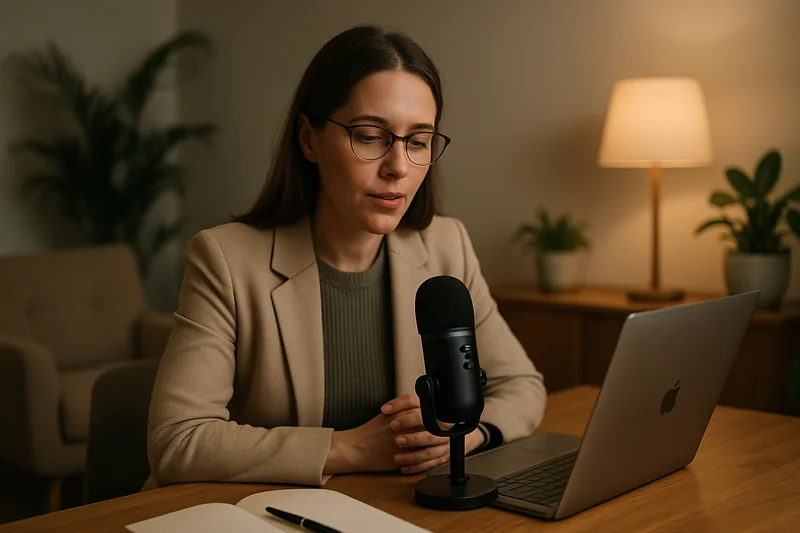
Use the five-minute window between sessions. Set a simple trigger: when a client leaves the room, open Infinity Dictate before looking at your phone or email. Speak the note. Review it. Paste it into your EHR. The note is done before the next client arrives. That single habit change, repeated consistently, recovers hours per week from the documentation load — and keeps evenings available for the rest of a demanding professional life.