Infinity Dictate Team
· 8 min read
Almost everyone has tried journaling at some point. Most people quit within a few weeks. The reasons vary — inconsistent routines, not knowing what to write, feeling like the process is too slow — but underneath most of those reasons is the same root problem: friction. The gap between what you're thinking and what ends up on the page is wide enough that the habit doesn't survive contact with a busy day.
Voice dictation directly addresses that friction gap. Speaking flows at roughly the speed of thought for most people — three to four times faster than typing. When you remove the bottleneck between thinking and recording, journaling becomes as fast as talking to yourself, which is something most people already do naturally. The result is more honest, more detailed entries — and a habit that's much easier to maintain.
Key Takeaways
- Typing friction is the most common reason people abandon journaling — voice removes that friction entirely.
- Speaking produces more honest, detailed entries because it flows closer to the speed of thought than typing does.
- AI auto-polish converts rough spoken output into readable prose without changing your meaning.
- Five minutes of voice journaling per day produces 400–500 words — a substantial archive over weeks and months.
- Dictated entries paste into any journaling app — Notion, Day One, Apple Notes, Obsidian.
Why Most People Quit Journaling
The journaling habit has a deceptively high dropout rate. Most people who start journaling — whether prompted by a book, a therapist's recommendation, or a personal resolution — stop within weeks. The most commonly cited reasons are lack of time, not knowing what to write, and the feeling that the output isn't worth the effort it took to produce it.
These reasons are real, but they're downstream of a more fundamental problem: the medium creates resistance. A blank page, a keyboard, and a self-imposed writing task activate the same perfectionist impulses that slow down any writing project. People edit themselves before they've said anything, second-guess what's worth recording, and then run out of momentum before the entry is done. The habit fails not because the person isn't motivated, but because the tool gets in the way.
The Friction Gap: Thinking vs. Typing
There's a measurable gap between thinking speed and typing speed. The average person types 40–60 words per minute under comfortable conditions. The average person speaks 125–175 words per minute in natural conversation. Thought doesn't have a speed exactly, but it flows much closer to speech than to typing — which means that typing creates a bottleneck between what you're thinking and what you're recording.
For journaling, this bottleneck has two effects. First, it slows down the raw capture of thoughts, which is the primary value of journaling. Second, it introduces editing: when you type slowly, you have time to reconsider and self-censor before the words reach the page. The result is that typed journal entries are often more polished and less honest than what you'd say aloud to a trusted friend.
Voice removes both effects. Speaking at natural pace, the flow from thought to text is nearly uninterrupted. The inner editor doesn't have time to activate. What emerges is closer to what you actually think — more raw, more specific, more useful as a record of your inner life. For a broader discussion of how voice changes writing habits, see our guide on why dictation feels awkward at first.
Voice Journaling: Speaking Your Thoughts Naturally
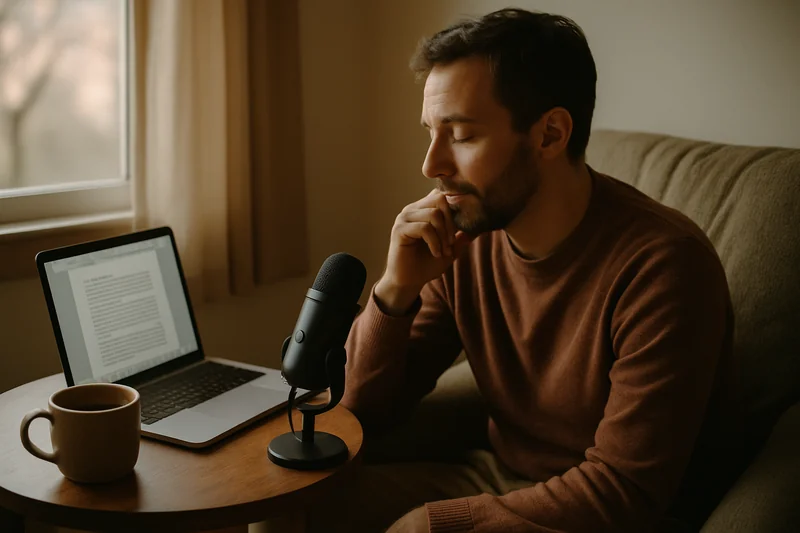
Voice journaling doesn't require a script or a format. The simplest approach is to open a blank document, activate Infinity Dictate, and speak as if you're talking to a trusted friend who wants to know how you're doing. You don't need to be eloquent. You don't need to stay on topic. You don't need to have a point.
What you'll find, if you try this for even a few sessions, is that the act of speaking your thoughts aloud — with no one listening, no judgment, no audience — is remarkably clarifying. Problems that felt vague become specific when you have to put them into words. Gratitude that felt abstract becomes concrete when you try to name what you're grateful for. Emotions that felt overwhelming often lose some of their intensity once they're articulated.
This is the core value of any journaling practice: externalizing internal content so you can look at it from the outside. Voice does this as effectively as writing — and for many people, more effectively, because it's faster and less self-conscious.
Building a Daily Voice Journal Practice
The most effective journaling habits are attached to existing daily routines. Morning coffee, evening walk, post-workout cool-down — these natural transition moments are the best places to insert a five-minute voice journal session. The trigger (coffee, exercise) activates the habit; the habit (voice journaling) produces value.
A simple five-minute structure that works for most people: one minute on how you're feeling right now, two minutes on what's occupying your mind most (work, relationships, health, a decision), one minute on what you're looking forward to or what you're worried about, one minute on what you want to be different or what you appreciate. This produces 400–500 words and covers the most useful journaling territory.
For people who want more structure, prompts work well with voice journaling. Speak the prompt aloud at the beginning of the session: "Today's prompt: what decision have I been avoiding and why?" Then just speak whatever comes. The spoken prompt activates the same reflection that written prompts do, but without the typing barrier. To understand more about reducing friction in writing habits generally, see our guide on reducing writing friction.
What to Do With Dictated Journal Entries
Once you've dictated an entry and AI auto-polish has cleaned it up, the most important step is saving it somewhere you'll actually find it later. Notion, Day One, Apple Notes, and Obsidian all work well as journaling apps. The key is consistency: always paste entries into the same place, with the date as the title or first line.
Over weeks and months, a dictated journal archive becomes genuinely useful. You can review what you were thinking about at a specific time, track patterns in your emotions or concerns, and observe how your perspective on recurring issues has evolved. This is harder to do with audio recordings (which require listening through) than with text (which can be scanned or searched). The text output from voice journaling gives you the speed benefit of speech with the searchability benefit of writing.
AI Auto-Polish: From Raw Speech to Readable Prose
One concern people have about voice journaling is that the raw transcription will be too messy to read. Spoken language includes filler words ("um," "like," "you know"), sentence restarts, and loose grammatical structures that look awkward in print. AI auto-polish addresses this directly.
Auto-polish cleans up filler words, smooths sentence structure, and makes the output readable — without changing what you said or adding content. The result reads like thoughtful writing rather than a transcribed monologue. Importantly, it preserves your voice, your ideas, and your meaning. The entry still sounds like you; it just sounds like a well-edited version of you rather than a raw transcript.
For journal entries where you want to preserve the raw spoken quality — including hesitations, stream-of-consciousness, and informal phrasing — you can skip auto-polish and paste the raw transcription. Both options are available; the choice depends on what you want the archive to feel like when you read it later. For more on how dictation can accelerate writing broadly, see our guide on writing faster with AI dictation.
One Week In: What to Expect
The first few voice journaling sessions will feel slightly awkward. Speaking to a microphone with no audience, while watching your words appear on screen, is a new experience for most people. The awkwardness passes quickly — typically within three to five sessions — as speaking becomes the obvious mode and the habit of self-editing while typing fades.
By the end of the first week, most people notice two things: their entries are longer than their typed journal entries used to be, and they feel more honest. The third thing people notice, usually in week two, is that the habit is sticking in a way that previous journaling attempts didn't. The friction is gone, and without friction, consistency becomes the natural outcome rather than the exceptional one.