Infinity Dictate Team
April 3, 2026 · 9 min read
Nursing is one of the most documentation-intensive professions in healthcare. Studies consistently show that registered nurses spend between 25% and 35% of their shift time on charting, documentation, and administrative tasks — time that is not spent at the bedside. The American Nurses Association has identified documentation burden as a leading contributor to nurse burnout, reduced job satisfaction, and compromised patient safety.
The underlying problem is a mismatch between how nurses work and how EHR systems are designed. Electronic health records were built to capture data comprehensively, not to support the cognitive flow of clinical care. The result is nurses who are excellent at observing, assessing, and intervening — but who spend significant hours translating those activities into structured text at a keyboard. Voice dictation directly addresses this mismatch.
Key Takeaways
- Nurses spend 25–35% of each shift on documentation — dictation directly reduces that burden.
- Micro-dictation between patient interactions produces more accurate notes than end-of-shift reconstruction.
- On-device AI dictation processes audio locally, eliminating cloud transmission of protected health information.
- Modern AI dictation recognizes standard clinical terminology including medication names, anatomical terms, and assessment findings.
- Dictation is most valuable for free-text narrative fields; EHR checkboxes and dropdowns still require manual input.
The Documentation Burden in Modern Nursing
The shift toward electronic health records was intended to improve care coordination and reduce medical errors. It succeeded in many respects. But it also moved documentation from a background task to a foreground one. Where paper charting could happen at natural pauses in care, EHR documentation often requires sustained periods at a workstation — navigating menus, entering structured data, and composing narrative text under time pressure.
For nurses on acute medical, surgical, or critical care units, the cumulative documentation load is substantial. A nurse caring for four to six patients will complete full assessments, medication administration records, care plan updates, and shift summaries for each — often while managing concurrent demands for patient care. Many nurses report staying past the end of their shift to finish charting, which contributes directly to fatigue and dissatisfaction. Reducing the friction in narrative documentation, even modestly, compounds across an entire shift.
What Nurses Actually Spend Time Documenting
Not all nursing documentation is the same. Some EHR fields — vital sign numbers, medication doses, checkbox assessments — require point-and-click or numeric entry that dictation cannot replace. The documentation where dictation adds the most value is the free-text narrative: the content that requires prose, clinical judgment, and complete sentences.
This includes: nursing assessment narratives (system-by-system observations, patient presentation, behavioral findings), response-to-intervention notes (how the patient responded to a medication or procedure), patient education documentation (what was taught, how the patient responded, what follow-up is needed), shift handoff summaries (the clinical story for the oncoming team), incident reports, and care plan update notes. These are the documentation tasks where the gap between speaking and typing creates the most friction — and where dictation compresses that gap most effectively. See also our guide on how physicians use voice dictation for comparison with similar clinical workflows.
Privacy and HIPAA: What Nurses Need to Know
Privacy is the non-negotiable constraint for any technology used in healthcare. The Health Insurance Portability and Accountability Act requires that protected health information — any data that could identify a patient — be handled with strict controls over who can access it and how it is transmitted. Cloud-based dictation tools create a meaningful HIPAA risk: the audio of a nurse dictating patient observations is itself protected health information, and transmitting it to a third-party server creates a chain of custody that must be managed, audited, and disclosed.
On-device AI dictation eliminates this risk at the source. When speech recognition runs entirely on the local machine — with no audio sent to a remote server — there is no transmission of PHI, no third-party data handling, and no network dependency. The dictated text appears on the nurse's screen without the underlying audio ever leaving the device. For nurses working in facilities with formal data governance policies, on-device processing is the most defensible approach. For a detailed technical comparison of on-device versus cloud dictation from a privacy standpoint, see our article on on-device dictation privacy and security. Always confirm your facility's specific policies before using any third-party tool with patient information.
Accuracy for Medical and Clinical Terminology
The practical question nurses ask about dictation is whether it handles clinical vocabulary — medication names, anatomical terms, clinical assessment language — accurately enough to be trusted without constant correction. The answer for modern on-device AI is broadly yes for standard clinical vocabulary, with some nuance for edge cases.
Terms like tachycardia, diaphoretic, bilateral breath sounds, peripheral edema, nasogastric tube, subcutaneous, and Glasgow Coma Scale are recognized reliably. Common medication classes — beta-blockers, ACE inhibitors, opioid analgesics — are handled well. Where accuracy can degrade is with unusual medication brand names, rare diagnoses with non-phonetic spellings, or heavy regional accent patterns on clinical terms. The practical solution is the same one physicians have used with dictation for decades: spell out anything unusual when you first dictate it, then correct during review. On a specific device used consistently by the same nurse, accuracy continues to improve as the recognition model adapts to that nurse's pronunciation patterns and vocabulary. For a full analysis of how AI dictation handles technical vocabulary across fields, see our article on AI dictation accuracy for technical vocabulary.
Using Dictation Between Patient Interactions
The highest-value moment for nurse dictation is not at the end of a shift — it is in the two to four minutes immediately after completing a patient interaction. Clinical memory is most accurate in that window. The assessment findings are fresh, the patient's words are retrievable, and the narrative constructs itself naturally.
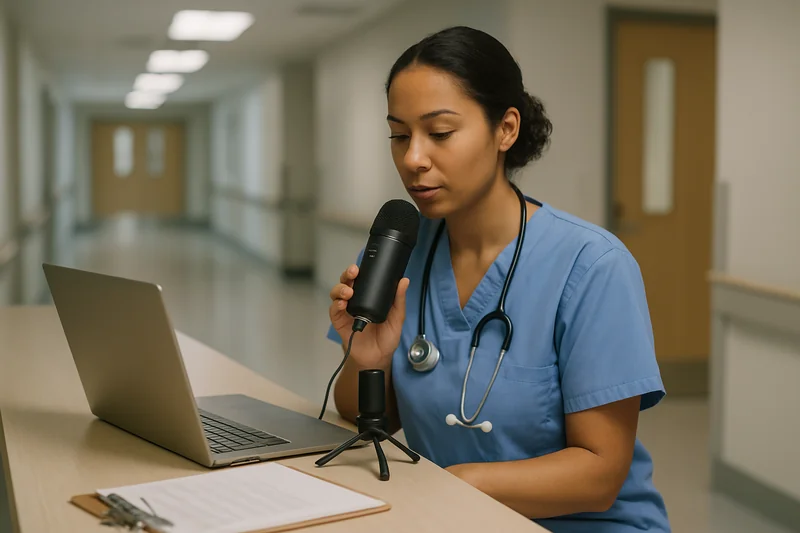
The micro-dictation approach works like this: complete the patient assessment or intervention, step to the nearest workstation or quiet corner, and dictate a 60–90 second spoken summary while the details are fresh. Cover the clinical findings in the order they would appear in the chart: subjective (what the patient reported), objective (what you observed and measured), your interpretation of the clinical picture, and the actions taken or planned. This spoken summary takes less than two minutes and produces a complete narrative that only needs minor editing before it goes into the EHR. The alternative — reconstructing the same information four hours later from memory and sparse notes — takes longer and produces less complete documentation.
On-Device vs Cloud: Why It Matters for Healthcare
The distinction between on-device and cloud-based dictation matters more in healthcare than in almost any other professional setting. Cloud dictation works by sending audio to a remote server where speech recognition runs, then returning the text. This is efficient for general use, but it creates three problems in a clinical environment: it transmits PHI to a third party, it requires a reliable network connection, and it creates audit and compliance obligations that most facilities do not want to manage with a consumer tool.
On-device dictation inverts this model. The AI model runs locally on the Mac. No audio leaves the device. Network connectivity is irrelevant. There is no third-party data processor to add to a business associate agreement. For facilities without formal IT procurement processes for third-party tools, on-device processing allows nurses to use dictation without triggering compliance review cycles. The trade-off is that on-device models require a capable local machine — modern Macs with Apple Silicon process on-device AI dictation with enough speed that the delay is imperceptible in a clinical workflow.
Getting Started Without Disrupting Your Workflow
The most common mistake nurses make when starting with dictation is trying to replace all documentation at once. A better approach is to start with one documentation type and build the habit before expanding.
Start with shift handoff summaries. At the end of each shift, instead of typing the handoff narrative, speak it. The handoff summary is a natural fit for dictation: it is prose, not structured data; it follows a consistent format (patient name, diagnosis, events of the shift, current status, pending items); and the time pressure of handoff motivates efficiency. After one week of handoff dictation, the workflow becomes automatic. Then add post-assessment dictation: immediately after your first full patient assessment each shift, dictate the narrative before moving to the next patient. Build the habit for one patient before scaling to the full patient load. Within two to three weeks, most nurses who follow this progression are dictating the majority of their narrative documentation and spending that saved time either at the bedside or leaving on time at the end of their shift.
Frequently Asked Questions
Is AI dictation HIPAA-compliant for nurses?
On-device AI dictation processes all audio locally on the device — nothing is sent to external servers. This means there is no cloud transmission of protected health information (PHI), which eliminates the primary HIPAA exposure associated with cloud-based dictation tools. For nurses in environments with strict data governance policies, on-device processing is the most defensible approach. Always verify your facility's specific policies before using any third-party tool with patient data.
How do nurses use dictation for charting?
The most effective approach is micro-dictation between patient interactions: after completing an assessment, step to the nursing station and dictate the key observations, vitals interpretation, and care actions while they are fresh. This produces more accurate and complete notes than reconstructing events at end of shift. Speak in clinical shorthand if that is natural — AI auto-polish can structure the output into complete sentences.
Can dictation handle clinical nursing terminology?
Modern on-device AI dictation handles standard clinical vocabulary well — terms like tachycardia, diaphoretic, bilateral breath sounds, and nasogastric tube are recognized accurately. For unusual medication names or rare diagnoses, spell them out the first time. Accuracy improves over time on a specific device as the recognition model adapts to your pronunciation patterns and clinical vocabulary.
What nursing documentation tasks benefit most from dictation?
Nursing assessments and observations, shift handoff summaries, patient education notes, care plan updates, incident reports, and end-of-shift narrative documentation. Form-based fields (vital sign numbers, checkbox assessments, drop-down fields in the EHR) still require manual input — dictation is for the free-text narrative portions where prose is required.
How much time can nurses save with voice dictation?
Studies on physician dictation show 30–50% reductions in documentation time. Nursing documentation has similar characteristics — large volumes of repetitive narrative text that maps well to spoken output. Nurses who dictate shift summaries and assessment notes consistently report completing documentation 20–40 minutes faster per shift, which translates to leaving on time more often and spending more time in direct patient care.