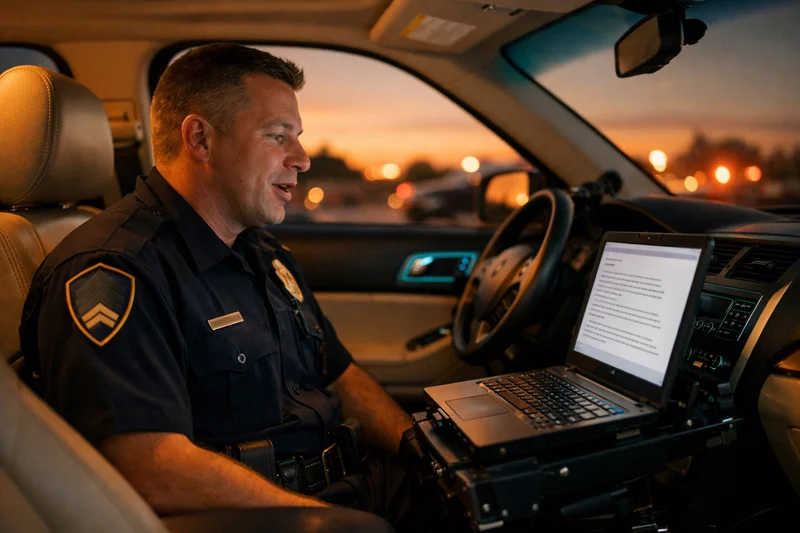
Every patrol officer knows the drill: you spend six hours responding to calls, conducting traffic stops, taking witness statements — and then spend two hours at the end of your shift typing reports. The paperwork backlog isn't just frustrating; it takes you away from patrol, delays case progress, and contributes to officer burnout.
Voice dictation software is changing how law enforcement handles documentation. Officers are now dictating incident reports in their patrol cars immediately after a call, recording witness statements on-scene, and documenting probable cause details while they're fresh. The result: faster case processing, fewer errors, and officers who actually get to go home on time. This isn't science fiction — it's already happening in departments across the country, and the technology has reached a level of accuracy and security that makes it viable for sensitive law enforcement work.
If you're new to AI voice dictation technology, this article will show you exactly how it works in real-world police scenarios — from traffic stops to crime scenes — and what to look for in a dictation solution that meets law enforcement security requirements.
Why Law Enforcement Needs Voice Dictation
The core problem is simple: officers are trained to protect and serve, not to be data entry clerks. Yet the average officer spends 30-40% of their shift on paperwork. In many departments, officers finish patrol at 6 PM and don't leave the station until 8 PM because they're catching up on incident reports. That's not sustainable.
Voice dictation addresses this by letting officers document events in real time, using natural speech instead of typing. Here's what that looks like in practice:
- Incident reports: Dictate narrative sections immediately after a call while details are fresh
- Witness statements: Record verbatim statements on-scene, then dictate your summary notes
- Probable cause documentation: Articulate observations, actions, and reasoning for arrests or searches
- Supplemental reports: Add follow-up details to ongoing cases without scheduling dedicated report-writing time
- Field interview cards: Document contacts and observations during patrol
- Vehicle-based reporting: Dictate from your patrol car between calls, using downtime productively
The time savings are measurable. Officers who adopt dictation typically cut report-writing time by 50-70%. A 30-minute typed incident report becomes a 10-minute dictation. That's an hour saved on a typical shift with two major calls.
Real Workflow: Traffic Stop to Completed Report
Let's walk through a real scenario: a DUI traffic stop. Traditionally, you'd take handwritten notes at the scene, transport the suspect, handle booking, and then sit down at a computer terminal to type the entire narrative from memory and scattered notes. By the time you're writing, details are fuzzy and you're reconstructing timelines.
With voice dictation, the workflow changes:
- Initial stop: You dictate initial observations into your phone while walking back to the patrol car after making contact ("License plate Alpha Bravo Charlie 1234, white sedan, pulled over at Main and 5th for failure to maintain lane, 11:42 PM")
- Field sobriety tests: After completing FSTs, you dictate observations before transporting ("Subject failed walk-and-turn, swayed during one-leg stand, strong odor of alcoholic beverage, slurred speech, bloodshot eyes")
- Booking process: While waiting at the jail, you dictate the chronological narrative of the stop, including Miranda advisement, refusal of PBT, and transport details
- Back at station: You open your records management system, paste the dictated narrative, make minor formatting adjustments, and submit the report — total typing time: 5 minutes instead of 45
The key difference: you're dictating contemporaneously, when details are accurate. The final report is more detailed, more defensible, and completed in a fraction of the time.
Accuracy Under Pressure: Dictation in Noisy Environments
One of the biggest concerns officers have about dictation is accuracy. Police work doesn't happen in quiet offices — you're documenting scenes with traffic noise, sirens, radio chatter, and wind. Will dictation software actually work in those conditions?
Modern AI-powered dictation handles this surprisingly well. The technology has advanced significantly:
- Noise cancellation: Software filters out background noise and focuses on your voice
- Domain-specific vocabulary: Systems learn law enforcement terminology (Miranda, probable cause, exigent circumstances, Terry stop, etc.)
- Contextual understanding: AI models recognize legal phrases and format them correctly
- Correction workflows: Quick voice commands let you fix errors without breaking flow ("scratch that", "new paragraph", "capitalize")
In practice, dictation accuracy for professional use now exceeds 95% in most field conditions. That's comparable to typing accuracy when you factor in typos and autocorrect errors. The difference is speed — you can speak three times faster than you can type.
For critical situations where accuracy is paramount (arrest warrants, affidavits), officers typically dictate a draft and then review it carefully before submission. The dictation gets you 90% of the way there in minutes; final review ensures legal precision.
Security and CJIS Compliance: Can Dictation Be Trusted?
Law enforcement handles sensitive information: victim identities, suspect details, investigative techniques, confidential informant information. Any technology used for police documentation must meet strict security standards, particularly CJIS (Criminal Justice Information Services) compliance.
Here's what to look for in a law enforcement dictation solution:
- End-to-end encryption: Audio and text should be encrypted in transit and at rest
- No cloud storage of sensitive content: Ideally, transcription happens locally on-device or in a secure, ephemeral cloud environment where audio is immediately deleted after processing
- Access controls: Integration with department authentication systems (Active Directory, SSO)
- Audit trails: Logging of who dictated what and when
- CJIS compliance: Vendor agreements that meet FBI CJIS Security Policy requirements
Many modern dictation platforms now offer on-premises or government cloud deployment options specifically for law enforcement. These systems process audio without sending it to third-party commercial servers. For a deeper dive into how dictation handles sensitive data, see our article on AI dictation security for professional use.
The bottom line: dictation can be secure, but you need to choose the right vendor and deployment model. Consumer-grade dictation tools that send audio to commercial cloud servers are not appropriate for police work. Enterprise-grade solutions designed for government and healthcare compliance are.
Legal Admissibility: Will Dictated Reports Hold Up in Court?
Officers often ask: if I dictate a report instead of typing it, will it be admissible in court? The short answer is yes — the method of input doesn't affect legal admissibility. What matters is the content, accuracy, and chain of custody.
Courts care about:
- Was the report written by the officer or under their supervision?
- Does it accurately reflect the officer's observations and actions?
- Was it created contemporaneously or shortly after the incident?
- Has it been altered or tampered with?
Dictation actually strengthens several of these factors. Because dictation is faster, officers are more likely to document events immediately after they occur, while memory is fresh. That contemporaneous documentation is more defensible than reports written hours later from fragmented notes.
Some departments even retain audio recordings of dictated reports as supplementary evidence. If an officer's recollection or wording is challenged in court, the original audio can demonstrate exactly what was said and when. This is an optional practice, but some prosecutors find it valuable.
From a legal admissibility standpoint, dictation is no different than handwriting, typing, or any other method of recording an officer's observations. The technology is transparent — the final report is still text in your records management system, reviewed and approved through normal departmental processes.
Choosing Law Enforcement Dictation Software
If your department is considering voice dictation, here are the critical factors to evaluate:
Security and Compliance
- CJIS compliance certification
- On-premises or government cloud deployment options
- End-to-end encryption
- Role-based access controls
- Audit logging
Accuracy and Usability
- Support for law enforcement terminology
- Noise cancellation for field use
- Quick correction commands
- Mobile and desktop support (patrol car laptops, smartphones)
- Offline operation capability (for areas without cell coverage)
Integration
- Compatibility with your records management system (RMS)
- Integration with CAD (Computer-Aided Dispatch) systems
- API access for custom workflows
Training and Support
- Vendor training programs for officers
- Technical support availability (24/7 for critical deployments)
- User guides and best practices documentation
For officers looking to try dictation individually before department-wide adoption, Infinity Dictate for Law Enforcement offers a free tier with professional-grade security and no usage limits — a good way to test the workflow without budget approval.
Key Takeaways
- Voice dictation cuts report-writing time by 50-70%, letting officers document incidents in minutes instead of hours and reducing end-of-shift paperwork backlogs.
- Contemporaneous dictation improves report accuracy by capturing details while they're fresh, rather than reconstructing events hours later from incomplete notes.
- Modern AI dictation handles field conditions with noise cancellation, law enforcement vocabulary recognition, and 95%+ accuracy in real-world police environments.
- Security and CJIS compliance are achievable with enterprise-grade dictation platforms that offer on-premises deployment, encryption, and government cloud options.
- Dictated reports are legally admissible — courts care about content and contemporaneousness, not the input method, making dictation a defensible documentation practice.
Frequently Asked Questions
Will dictation software understand law enforcement terminology like Miranda, probable cause, and Terry stop?
Can I use dictation in my patrol car while the engine is running and the radio is on?
Is my dictation secure? Can the vendor access sensitive case information?
What happens if the dictation makes an error in a critical detail, like a suspect's name or vehicle plate?
Can I use dictation for arrest warrants and affidavits, or is it only for informal incident reports?
Voice dictation isn't a replacement for good policing — it's a tool that removes administrative friction so officers can focus on the work that matters. When you spend less time typing and more time on patrol, everyone benefits: cases move faster, reports are more accurate, and officers get home on time. If you're still spending two hours at the end of every shift catching up on paperwork, it's worth exploring how modern dictation technology can change that workflow.